Since we last talked
A CRM knows what you told it, not what happened since. Blake now reads the outside world for you. Every Sunday it checks the companies behind your serious deals for funding, new sites, leadership moves, launches and pricing changes, keeps only what touches your business, and puts it on the deal under Since we last talked and in the Monday email. The first of three posts on the market radar.
You walk into a call with a prospect. You know their deal stage, their contacts, the last three emails. What you do not know is that they announced a new warehouse in Germany on Tuesday, or that their CFO left last month. They know. You find out halfway through the call, which is the worst possible time.
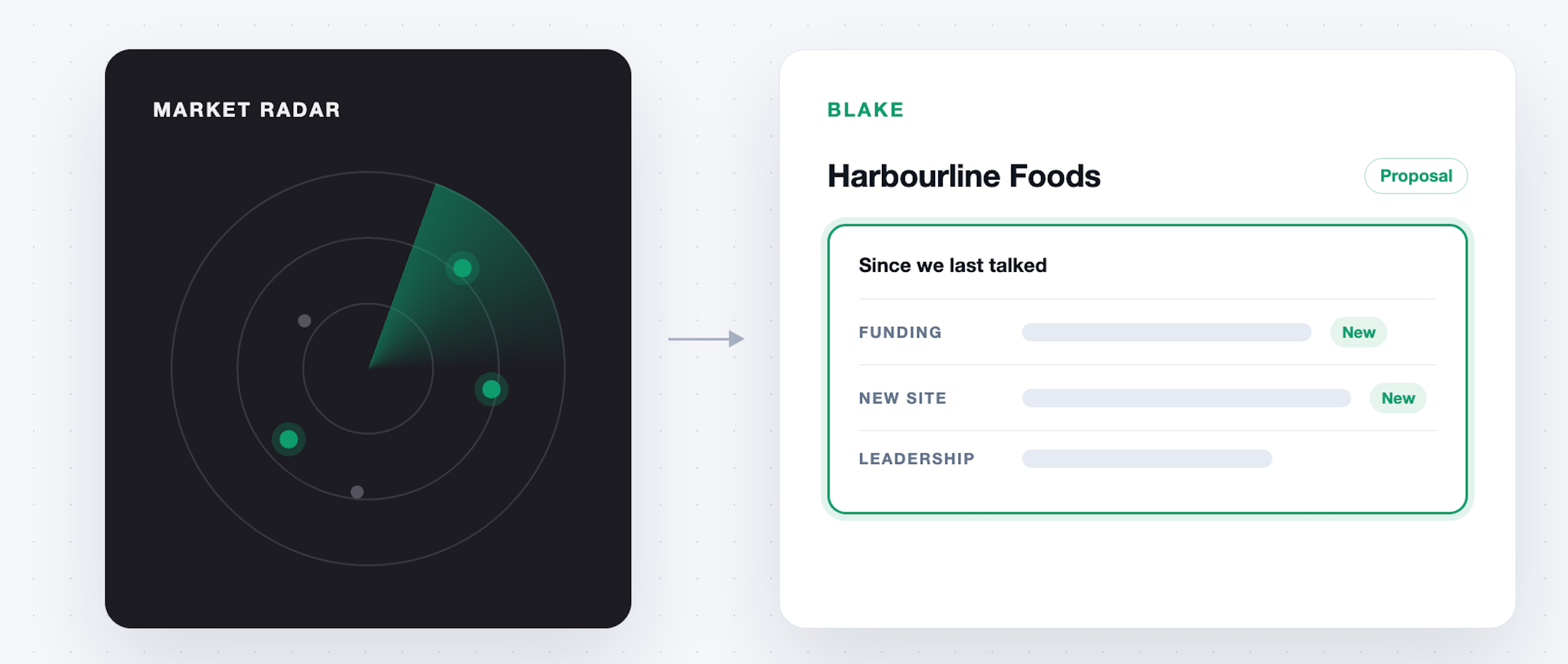
A CRM knows what you told it. That is the problem. So I started reading the outside world for you.
This is the first of three posts on the market radar: your open deals today, then the competitors you lose to, then the customers you already won.
Since we last talked
Once a week I check the companies behind your serious deals and tell you what changed. Funding, acquisitions, launches, pricing, new sites, people arriving and leaving, layoffs, big customer wins. If their website changed in a way that means something, a new product or new pricing, I notice that too. Rotating banners and cookie notices I leave alone.
It shows up where you already work. Open a deal and the panel at the top is called Since we last talked: everything I found since your last note, email or stage move, marked New. The same findings sit on the company page. And because I scan on Sunday evening, the Monday email gets a Market radar section with the findings attached to your biggest deals, before your week starts.
Only the deals that matter
I do not watch everything. A lead you emailed once does not need a weekly briefing. I watch deals at 50% probability or higher, Proposal stage onwards in a standard pipeline, and anything rated Cadillac from the first touch. That is where the news actually changes the conversation.
So the list stays short, and it moves with your pipeline. A deal that climbs to Proposal joins the watch the following Sunday. A deal you lose drops off it.
Relevant to you, not just true
The internet produces a lot of true things that do not matter. A logistics giant sponsors a football club. A software company wins a design award. True, and useless to you.
So I judge every finding against your own business: the company profile and the ICP your admin keeps under Admin, ICP. What you sell, where you sell it, who you sell to. A prospect opening a new distribution centre matters if you move freight. It does not if you sell accounting software. If a finding does not touch what you sell, you never see it.
And if I still get one wrong, there is a Not relevant button on every finding. Press it and it is gone, and I skip anything like it from then on.
What a good finding looks like
One line you can use in the first minute of the call. "Saw you opened in Rotterdam, how is the volume settling in?" lands better than any discovery question you prepared. It tells the buyer you pay attention, and it moves the conversation to the thing that is actually on their mind this month.
That is all the radar is for. Not a news feed. A reason to call, and something worth saying when you do.
Switching it on
The market radar is off until an admin switches it on under Admin, Overview. Then make sure your ICP says what you actually sell, because that is how I decide what is relevant. The setup checklist on the pipeline walks you through it, and the help pages have the details.
Next in the series: competitors, and the page that shows who you lose to.
Walk into the next call already knowing. That is the job.